
Author: Jason Rittenberg
-
Commerce Department’s Regional Tech Hubs – Where do they stand today?
Post by Jason Rittenberg appearing on New America To grow regional economies around the sunrise industries of the future, leaders from both parties have begun embracing new federal tech-based economic development investments. The objective of these investments is to foster tech-based growth coalitions in regions left behind by the 20th-century rise of Silicon Valley and…
-

Innovating legacy sectors: Mass timber poses new opportunities for construction & forestry
Portland, Oregon may offer the best demonstrations of mass timber. Visitors are welcomed with the beauty of the new PDX atrium. The Julia West House, a 12-story senior transition house featuring wood ceilings and constructed by a local specialty firm, Carpentry Plus Inc., is just one of the impressive examples downtown. These use cases, however…
-

Excel produces rigorous Cluster Identification course
Excel Regional Solutions has published a course on Cluster Identification for the Center for Cluster Development, a nonprofit project funded by a national philanthropy (and under fiscal sponsorship by the Federation of American Scientists) to produce cluster resources that benefit regions of all sizes and capacities. Why a course on cluster identification? Cluster identification is…
-
Congress approved innovation funding, but agencies haven’t decided when programs will move forward
Guest post by Jason Rittenberg appearing on Technical.ly … Build to Scale is just one federal initiative that regions use to advance tech, science and entrepreneurship initiatives — and it is not the only one that seems to have an uncertain future despite support in Congress. Many stakeholders breathed a sigh of relief after Congress used the…
-

Promising states for AI accelerator-stage companies
Startups working with artificial intelligence and looking for a home while they work through accelerators or incubators likely are headed to California—but many other states not only have strong levels of activity but may feature better market fits for certain entrepreneurs. For example, over the past five years Minnesota has nearly matched California’s rate of…
-

Lansing, Minneapolis top metros for health device deal concentration
A new analysis by Excel Regional Solutions studies venture capital investment into companies working in healthcare device and supply, a sector that has seen nearly $42 billion in investment over the past five years. From 2021-2025, the metros with the greatest relative concentration contain a mix of regions known for life sciences research, the U.S.…
-

Clusters feature prominently in local strategies
More than six in seven local economic development districts are pursuing at least one industry cluster goal, according to an analysis of recent Comprehensive Economic Development Strategies (CEDS). These strategies cover sectors ranging from advanced manufacturing to tourism and leverage tactics as diverse as business recruitment, technology development, and workforce training. The prevalence of sector-specific…
-

Investment tax changes could affect regional strategies
The recent tax law[i] has numerous implications for regional economic development strategies, which we will dig into in this blog. First up: Qualified Small Business Stock. Many regional tech-based economic development strategies address capital access for startups at least partly by encouraging high net worth individuals, or angels, to invest in local startups. The U.S.…
-
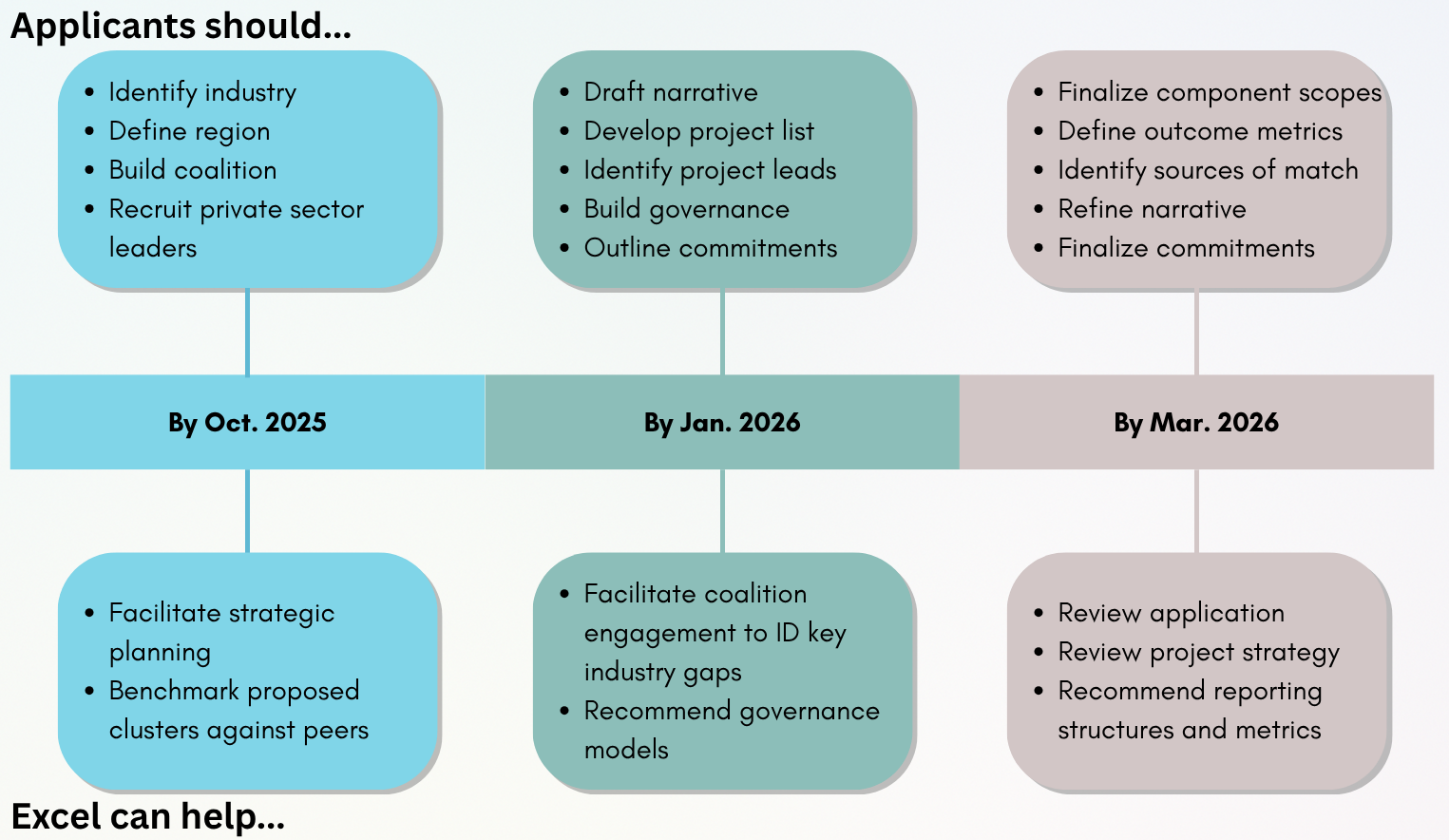
EDA disaster funding recommits to Tech Hubs approach
The U.S. Economic Development Administration (EDA) has opened a funding opportunity for communities affected by disasters over the past few years. The competition includes an “industry transformation” path that borrows much from the agency’s model for the Tech Hubs, Build Back Better Regional Challenge (BBBRC), and Recompete programs: applicants propose 3-5 projects that are designed…
-

Share your region’s sector strategy & success!
Has your region had success with an economic policy, initiative, or strategy focused on a specific tech sector? Are you proud of how you developed this work or of one of the successes it has helped your region achieve? Do you have lessons that could benefit other communities who are developing their own cluster development…