

Portland, Oregon may offer the best demonstrations of mass timber. Visitors are welcomed with the beauty of the new PDX atrium. The Julia West House, a 12-story senior transition house featuring wood ceilings and constructed by a local specialty firm, Carpentry Plus Inc., is just one of the impressive examples downtown. These use cases, however impressive, are only the surface of the mass timber industry. Upon exploring the broader Pacific Northwest Mass Timber Tech Hub, it becomes possible to see the transformative potential of mass timber across the manufacturing, construction, and forestry sectors. The field offers lessons not only for stakeholders in the Pacific Northwest, but also for policymakers and economic developers in other regions seeking to modernize legacy industries.
Mass timber is not just a lot of wood
Someone hearing about the industry for the first time would be forgiven for thinking that the mass timber industry is focused on supporting construction that involves a lot of wood. Or, perhaps, using really big pieces of wood. Both are true, but only to a degree.
The real focus of the mass timber industry is on engineered wood products that are fabricated into larger and stronger pieces than can be achieved by conventional timber alone. Mass timber engineering processes include laminating (e.g., cross-laminated timber [CLT]), gluing (e.g., glulam), and nail- or dowel-based joining.
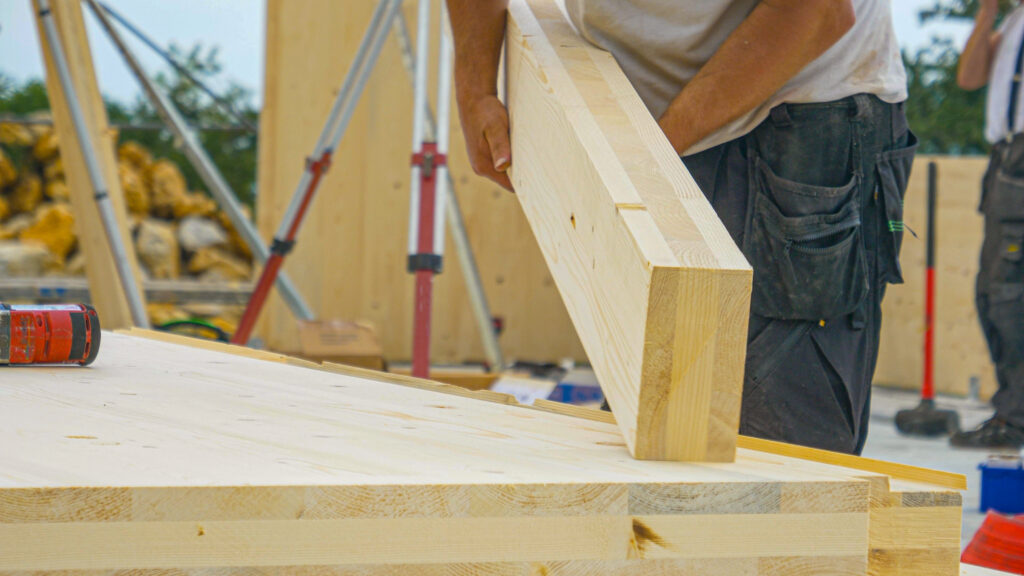
The products and buildings that mass timber can yield are truly impressive.
Oregon State University is home to several excellent examples of the technology’s construction capabilities. The forthcoming Huang Collaborative Innovation Complex is built from mass timber yet will house a supercomputer—equipment that produces tremendous sound and vibration and requires constant cooling—and the building will serve as a local earthquake shelter. Across campus, the Peavy Forest Science Center features CLT shear walls and tension cables that can reset after an earthquake (with modular replacement of damaged pieces, if necessary).
Mass timber performs remarkably well under more direct stress. Columns made from the products are more fire resistant than steel. Panels can withstand ballistics testing and are being explored for use in military bases.
One critical benefit of mass timber is its implications for construction time and cost. While engineered wood materials still cost more than comparable steel or concrete, mass timber is streamlining construction operations, removing expensive change orders and reducing the cost of construction labor and placing buildings in service faster. Much of this efficiency derives from the processing of mass timber panels, which typically are pre-cut to project specifications and labeled with QR code trackers so that construction workers can put the pieces together, not unlike a puzzle.
Mass timber also represents new opportunities for forestry in the Pacific Northwest. This sector faced significant challenges due to changes in environmental regulation in the early 1990s and has experienced unsteady demand over the past two decades. If mass timber construction takes off in popularity, this new source of rising demand could provide a tremendous boost to the region’s forestry sector. Another opportunity for the sector comes from mass timber’s potential to find commercial uses for wood that is a poor fit for traditional timber products—a development that has the potential to make smart forestry management and reinvestment financially viable to a far greater extent than has been true to date.
Innovation in and out of the lab
The Pacific Northwest Mass Timber Tech Hub, designated by the U.S. Economic Development Administration in 2023, is led by Oregon State’s TallWood Design Institute. This center conducts academically-driven research, testing and product development services for companies, and facilitates an industry research consortium. Over the years, the Institute’s research has, among other things, helped identify the structural performance of different types of wood used in mass timber products and the economic impact of mass timber construction. The facility can conduct earthquake testing and is constructing a fire lab that will enable testing of structure and other fire types.
University of Oregon is another key member of the consortium and creator of the new Oregon Acoustic Research Laboratory. This facility, which will be co-located at the Portland Port’s Housing Innovation Campus—a product of the region’s federally-funded Build Back Better Regional Challenge, is focused on conducting critical sound testing that will inform and accelerate efforts to construct more housing and commercial buildings with mass timber.
One of the most exciting developments emerging in Oregon is the amount of innovation taking place within the industry. Small businesses have patents on new types of mass timber products, and construction firms are experimenting with new methods and business models that leverage mass timber production and supply.
This activity exemplifies robust production innovation: technological advances that improve the way materials are produced and assembled (in this case, via construction).
America has abandoned our capacity for production innovation in industry after industry as we have allowed other countries to manufacture the products that we discover and design. Novel innovation (i.e., original discoveries) often is prioritized by regional leaders who want to cultivate a tech economy, but this typically requires a specific type of skill and asset concentration that may not translate into broad economic gains without the right downstream capacity. Some of these same regions miss more realistic and impactful opportunities to translate existing capabilities into near-term new investments, job creation, and products, as well as the long-term potential to achieve novel discoveries and advantages along the entire industry supply chain. The structural benefits of emphasizing production innovation can be seen in China’s success at leveraging its manufacturing expertise into leadership roles in increasingly complex and innovative technology areas.
Mass timber shows how production innovation can anchor regional competitiveness and job creation (as a critical expansion of cutting-edge research that also is occurring in locally). New production innovation solutions already are benefitting the Oregon economy, including the Mass Ply products developed by Freres Engineered Wood and the Timber Core modular stair core system created by Carpentry Plus.
Threats to American dominance
The Pacific Northwest has strong building blocks to lead in mass timber: proximity to raw materials and suppliers, a concentration of firms working in the sector, an economic legacy in related work, and policymakers and stakeholders who are willing to prioritize the sector. However, other countries are interested in mass timber and have advantages of their own.
Canada, for example, has a strong mass timber sector that has benefitted from experienced construction and manufacturing firms, proximity to its own sources of raw materials, and a favorable policy environment (including financial support designed to offset the effects of U.S. tariffs for Canadian firms that import to America). British Columbia alone provides 15% of North America’s supply of mass timber products and is seeking to grow its market share.
Europe poses another type of threat to the Pacific Northwest’s industry leadership. In many, if not all, Oregon mass timber manufacturing sites, domestic products are being created with foreign equipment, particularly European computer numerical control (CNC) machines. The supply situation is not as dire as in semiconductor manufacturing, which owes 100% of its production machines to one Dutch company, but is a clear risk to the independence of America’s mass timber industry. This threat could become a particular concern as Europe’s own mass timber sector is on track to double in scope over the next few years, and American-European trade relationships become increasingly tense.
In short, the long-term success of the Pacific Northwest’s mass timber industry partly depends on how its critical suppliers and customers are affected by the changing global economic context. If Canadian products become extra competitive due to subsidies or other practices, then domestic markets may want to explore operational subsidies or other support that fosters growth (without undermining pressure to continue improving and competing) to preserve market share. Should trade with Europe become more difficult or costly, the region may need to prioritize securing domestic production of CNC machines used for mass timber products or risk unsustainable increases in operating costs. International competition raises concerns for policymakers and practitioners that extend well beyond their jurisdiction, but these threats and opportunities must factor into the region’s economic development approach.
Lessons from the Pacific Northwest’s mass timber industry
The Pacific Northwest’s mass timber industry illustrates a few issues other regions and sectors have been experiencing over the past decade:
- The region’s leadership in mass timber did not come from a single actor, but from sustained attention and investment across a variety of manufacturers, research institutions, construction firms, and economic development practitioners. This distributed approach should contribute to an effort that captures a greater breadth of the industry’s needs and that can prove more resilient to organizational and personnel changes.
- Innovation policy must consider regional opportunities and needs beyond laboratories and startups, including production capabilities, workforce development, technology adoption, and global markets. Fostering these connections is essential to realizing meaningful economic opportunities across more of the region’s people and businesses.
- Legacy sectors can be revitalized through innovation, particularly when innovation is applied not only to what is created, but also to how it is produced, coordinated, and scaled. Economic development strategies for these sectors need to extend beyond novel discoveries and fully incorporate tech adoption and production innovation.
- Any transformational economic effort requires a great deal of time, and maintaining momentum typically is only possible when coordinating entities are empowered to continue to focus on supporting the effort. Regions that do not see this reality reflected in state and local funding must piece together the necessary resources to achieve success.
Other regions looking to build their innovation activity and capacity should consider these factors in designing strategies to build their priority sectors.
Aligning history to the future
What makes the Pacific Northwest Mass Timber Tech Hub example powerful is that the region has found a path that can bring its economy into a technologically-driven future without abandoning the legacy that originally made the region vibrant.
Many regions are eager to jump onto emerging technology sectors, a choice that can make great economic sense when they possess the assets and talent to gain and sustain a competitive advantage. Even when successful, it will be generations before those new sectors accrue any personally meaningful connection to the region. More importantly, regions that do not achieve traction with new industries may have missed an opportunity to help a legacy reinvent itself by adopting the latest productivity-improving tools or by expanding into related technologies.
The Pacific Northwest is attempting this latter path. The evidence of the forestry industry’s history was everywhere, and some of the companies involved in mass timber have been manufacturing wood products or involved in local construction for decades. These regional stalwarts are being joined by innovators to forge something that is both familiar and novel, and the resulting story of creating new economic opportunities and sustainable, efficient products and processes for sectors that have not been known for innovation in decades is undeniably exciting.